![[back]](/assets/home_24dp_E3E3E3_FILL0_wght400_GRAD0_opsz24.svg "[back]")
![[search]](/assets/search_24dp_E3E3E3_FILL0_wght400_GRAD0_opsz24.svg "[search]")
S1E3 - Dragons Fire Satanic Initiation
Video: [link]
- Introduction
- Aryans
- Drawing, Pulling, and Stars from the Sea - Aruou (ἀρύω)
- The arioi (αριοι) the ancient name of the Medes
- Drawing the Stars
- Cannabis
- Eos (Ἑως), mother of Lucifer
- Back to the dragon and the oistros
- chriou (χριω)
- After Rob Joins
Introduction
I need to reiterate the two principles:
- We follow reason in this Temple space that we have constructed. we follow reason.
- Any of our efforts are thwarted by profit. Anybody choosing to profit off of this Sacred Space is polluted and to be outcast.
Let's proceed then with the purification.
It's my honor and privilege tonight to introduce you to the dragon.
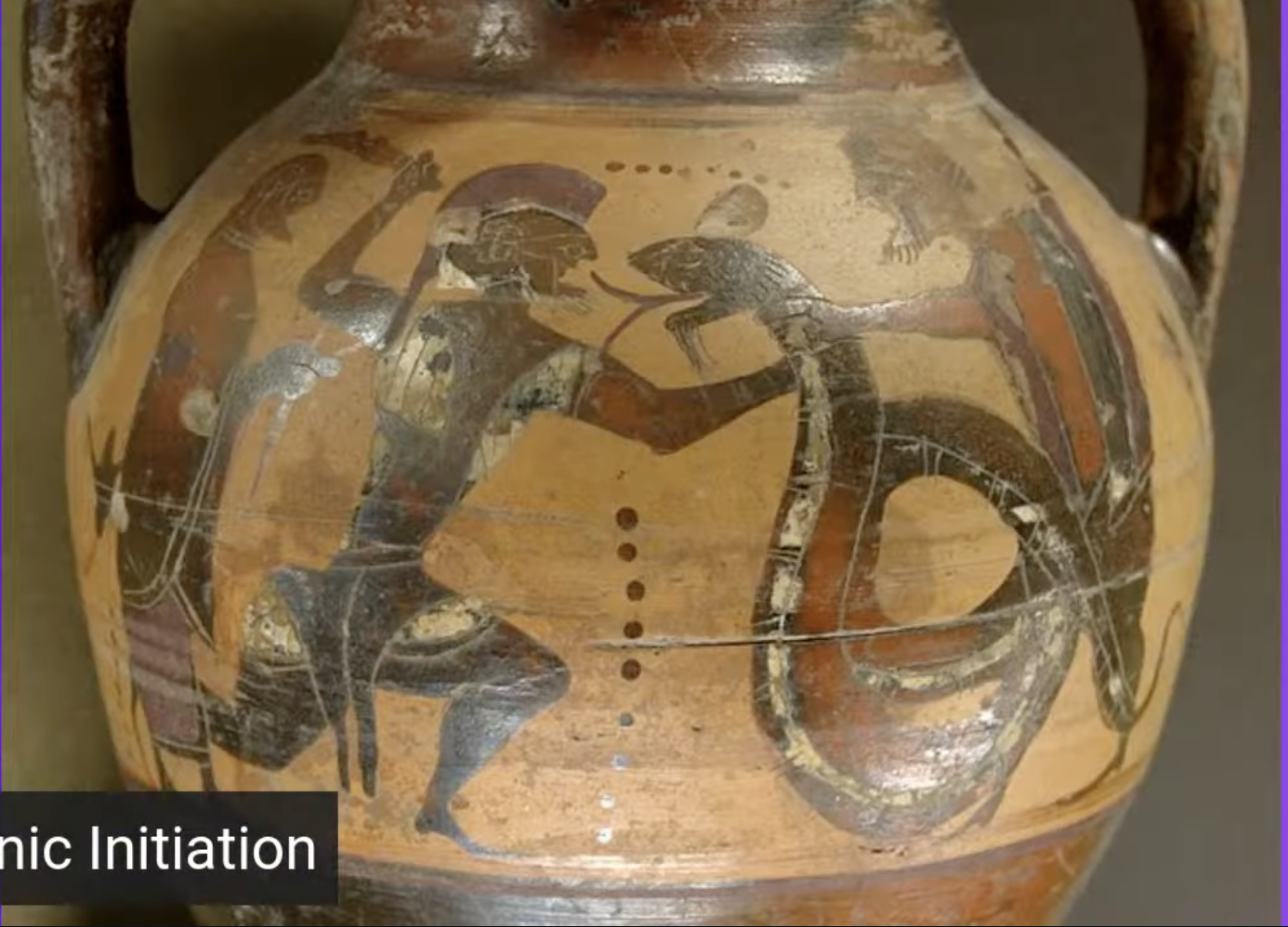
I'm warning you there's quite a bit of esoteric meaning and ritual and linguistics.
Aryans
Part of "Nick's" letter
Anacharsis - Kind of the George Washington of the Scythians.
- But he's late, like 6th BCE, well after the Scythians' peak.
I'm going to take you back, and make you look into the face of that Queen.
So what do we say about Aryans?
His people took the name AriansNotice Arians here is with an i
And all of a sudden you smell.. what do you smell? 1898.
and you smell some Scholars and some intellectuals in Germany.
Descendants of them are now in places like Iran, Ireland, Romania, Armenia, Etc.
It's the sources that matter
You're like a detective when you look at history. You have to piece things together -- that cadaver was shot but if you don't find a hole and a bullet you've got problems.
There will be those of you who will be seduced by the academics.
Once you're in these texts that provides you with an immunity.
There's two types of people -- people who know this evidence, who can read it, and those people who read every day, they wake up in the morning, they read ancient Greek.
I'll show you in a minute how the victorians very nicely sifted out for us but that by the time of Strabo, there's this active debate about what's the real root right is it -- Alpha rho upsilon -- αρυ or is it -- Alpha rho iota -- αρι?
and Nick would be jumping around saying "this is a Sanskrit route". It's not!
On the Greek side this word has its own derivation.
and I'll show you the texts that talk about that derivation
and I'll show you cannabis in Antiquity.
The question tonight is: What is the street name of cannabis, In Antiquity?
I can't wait to show you.
We saw an email from someone named Nick, admonishing Dr Hillman for the topics he studies, specifically the concepts of both satan and pedophilia found in the Ancient Greek Language source texts.
Nick, no one advocates for the pedophilia, especially Dr Hillman or anyone associated, yet it exists in the historical texts. Why should he distance himself?
Dr Hillman's field of study is sometimes mis-understood as "support", and Nick here wrongly attributes support where it doesn't exist.
Only the sources matter. It's an inquiry of history.
See LadyBabylon FAQ
Drawing, Pulling, and Stars from the Sea - Aruou (ἀρύω)
Look at Aruou (ἀρύω) here:
A.“ἀρυτήμενοι” Alc.47: impf. “ἤρυ^ον” Hes.Sc.301; “ἄρυον” Hsch.: aor. “ἤρυ^σα” Pherecr.138, X.Cyr.1.3.9:—Med., “ἀρύτομαι” Ar.Nu.272; “ἀρύομαι” Aeschin.Socr.11, AP9.37 (Tull. Flacc.), etc.: fut. ἀρύσομαι [υ^] AP9.230 (Honest.), Luc.DMar.6.1: aor. “ἠρυ^σάμην” Plu.2.516c; opt. “ἀρυ^σαίμην” E.Hipp.209 (lyr.); inf. “ἀρύσασθαι” X.Cyr.1.2.8; part. “ἀρυ^σάμενος” Hdt. 8.137, Ep. “ἀρυσσάμενος” Hes.Op.550:—Pass., aor. “ἠρύθην, ἀπ-αρυ^θείς” Alex.45.6; also “ἀρυσθείς” Hp.Nat.Puer.25, Plu.2.690b:—draw water, wine, etc., τοὶ δ᾽ ἤρυον others drew off the must, Hes.Sc.301; “ἀρυόντεσσιν . . ὕδωρ” Simon.45; “ἐκ πιθῶνος ἤρυσαν ἄκρατον” Pherecr. l. c.; “ἀρύσαντες ἀπ᾽ αὐτῆς [τῆς φιάλης] τῷ κυάθῳ” X.Cyr.1.3.9; “μέλισσαι νέκταρ ἀρύουσιν” Lyr.Alex.Adesp.7.18: metaph., κἂν ἐκ Διὸς ἀρύτωσιν if they draw inspiration from Zeus, Pl.Phdr.253a.
II. Med., draw water for oneself, ἀρυσσάμενος ποταμῶν ἄπο having drawn water from . . , Hes.Op.550; “σφῷν ἀρύσασθαι” Pherecr.130.5; “ἀρύσασθαι ἀπὸ τοῦ ποταμοῦ” X.Cyr.1.2.8; “ἐκ τοῦ κρατῆρος” Pl.Criti.120a: c. acc., “ἀρύσασθαι ὑδάτων πῶμα” E.Hipp.209; “ἀ. ἐκ τῶν ποταμῶν μέλι καὶ γάλα” Pl. Ion534a: c. gen. partit., “ὑδάτων ἀ. πρόχοισι” Ar.Nu.272; ἐς τὸν κόλπον τρὶς ἀρυσάμενος τοῦ ἡλίου having (as it were) drawn the rays of the sun into his bosom, Hdt.8.137: generally, draw in, τροφῆς καὶ πνεύματος Diog.Bab. ap. Gal.5.281; “μαντικῆς” Plu.2.411f; πλοῦτον Id.Caes. 29; “καιροῦ καὶ τύχης” Eun.Hist.p.256 D.2. of stars rising from the sea, “οἵ τ᾽ ὠκεανοῦ ἀρύονται ἀστέρες” Arat.746.
Notice that this verb in greek is some type of drawing, pulling, a movement... toward the one performing the action
- And Stars rising out of the sea
We have the same root in words like Hera (ἣρη), and Ares (ἂρης).
- aruou (ἀρύω) = Drawing force upward into manifestation.
- Hera (ἣρη) = Drawing force into order
- Ares (ἂρης) = Drawing force upward from depth
Shared roots:
- You'll notice right away that we have names of gods creeping in.
- You're "in the right cult" (context of the sources, not a literal cult, sheesh)
Why can't we turn away from the pedophilia by the way? Why can't we?
- When I went to the University of Wisconsin, I discovered where the ceiling was. So I picked up a rock and I shattered it. And I said from now on, I'm always going to break through the ceiling, because the establishment there was saying "you cannot say that the founders of Western Civilization use drugs", you can't say that, and after seeing what I had seen you know it wasn't hard for me to say "Hey you know Marcus Aurelius and those meditations you love to read?" - Professor so and so from Ireland (you know who you are).
- You have to realize what's what's going on with some of the material that's around you, and they didn't want to do this.
It starts here with aruou (ἀρύω).
What are you raising out of the sea?
Well, we're raising Aryans.
The arioi (αριοι) the ancient name of the Medes
I want to show you the arioi (αριοι) and how it is that the victorians define them.
The ancient name of the Medes!
A.Medes, Hdt.7.62; Μάγοι καὶ πᾶν τὸ Αριον (Ἄρειον codd.) “γένος” Eudem. ap. Dam.Pr.125 bis; ἔκοψα κομμὸν Ἄριον (Ἄρειον codd.) a Median lament, A.Ch.423 (lyr.):—hence Ἀριανή , ἡ, name of the eastern Iranian highlands, Str.15.2.1: Ἀριανοί , οἱ, its inhabitants, D.S.2.37, cf. 1.94, Ael.NA16.16 (cf. Avest. Airyana).
II. inhabitants of the Persian satrapy of Ἀρεία (Arr.An.3.25.1), Pers. Haraiva, Hdt.7.66; written Ἄρειοι, Id.3.93, Arr.l.c.
Notice: The Iranian highlands; Later with respect to Persia.
This is a section of Herodotus
After Medea arrived from Athens (Which Medea or which medwa? The Colchian medwa). After she arrived from Athens, the people there, the Aryans changed their name to the Medea to suit her and this is what they all call themselves
- So, they changed their genos (γενος), they changed their ethnic name.
I just want you to notice that the victorians are noticing that the root is changing from the ari- (αρι-) to the aru- (αρυ-), and why is it why would we have we can read here at the bottom modern philology gives the name Aryan
This is a linguistic debate at the time, (because there are these excellent things) and these are the authors that these people who claim knowledge and just give you generalizations.
- anytime you get a generalizations it's bunk
(You know we're detectives. This is history and we're detectives you better bring me some evidence and you better lay it out)
Religious historians love the ideas and the theories
- they're not so good with the actual evidence
So what about these Aryans, aruou (ἀρύω), that "drawing" is the very thing that the Medoi become known for doing - that connection to "drawing down".
- They had an expression: "to draw down the Moon".
- Can anybody draw down the Moon?
Drawing the Stars
Can you draw the Stars?
- You can draw a third of them, if you've got the right tail
- Why would you want to "draw" Stars? Aren't those the things that we look up at? They're just balls sending a feint old light hitting us....
In order to get there to those Stars we got to go through a dragon, who is protecting a Sacred Space.
What is a dragon?
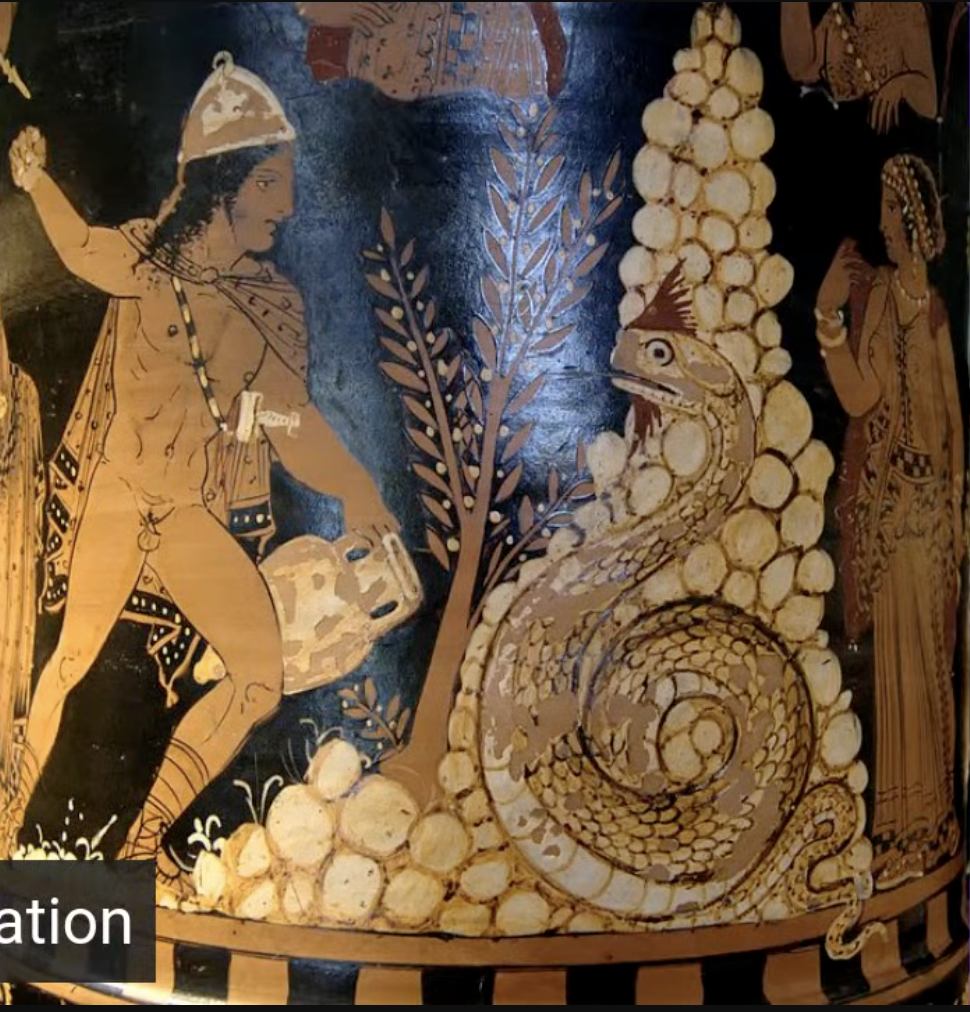
A.dragon, serpent, Il.11.39, al.; interchangeable with ὄφις, 12.202, 208, cf. Hes. Th.322, 825, Pi.N.1.40, A.Th.292 (lyr.); “ἀετὸς καὶ δ. πολέμια” Arist.HA609a4; perh. a water-snake, ib.602b25.
II. the constellation Draco, Arat.46, al., Man.2.69.
III. a sea-fish, the great weever, Epich.60, Arist.HA598a11, Hp.Vict.2.48.
IV. = κηρύκειον, prob. a wand with a serpent coiled round it, S.Fr.700 (cf. 701).2. serpent-shaped bracelet or necklace, Luc.Am.41.
3. a noose or crossed bandage for the ankle, Heraclas ap.Orib.48.5.1.
4. dragon-standard, Lib.Or.1.144, Them.Or.18.219a, cf. Or. 1.2a: hence, corps of 1,000 men in the Parthian army, Luc.Hist. Conscr.29.
- Notice right away at the top they tell you it's from Derkomai (δερκομαι)
- etymologists / linguists figured out where these words came from.
- This Derkomai (δερκομαι) is my favorite. It's only because he says "Ammon is the Antichrist", I don't know why.
By the way, we cannot give up that pedophilia:
- We must track down the source of this saturnian, satanic... I can't abandon the saturnian way.
- I can't stop people from seeing via these dead people (via these sources) that Judaism and Christianity are inventions of saturnian or satanic Magic.
Yeah, I'm gonna show you Moses's stick here in a second...
All of these words come from somewhere. they all have roots and these roots have histories. they're their own organisms.
Back to the dragon (δράκων), what is it?:
- The dragon is a serpent...
- The constellation Draco...
Look at Roman numeral number iv:
- kerukion (κηρύκειον) - Α wand with a serpent coiled around it (sounds like a caduceus); Something that a kerux (κηρύξ) "carries around"
Who's the kerux (κηρύξ)?
- He's a messenger.
- He's a messenger of god.
- What does he carry around? A thing called the kerukeion (κηρύκειον) and...
What are the victorians pointing out there under dragon (δράκων)? It's a wand, with a serpent coiled on it.
So the drakon (δράκων) is the wand with the serpent coiled.
For those of you who want to jump ahead to Jung (shut up, Jung!).
You'll find the serpent wand, and who has it?
- Who possesses it in the red book?
- It is the girl who is half virgin / half Viper!
Did Jung know about dragons?
- I think he knew a thing or two
- and the seal on his text proves it
We have two sources that tell us the dragon, like the wolves, are Temple Guardians.
- And we know they're individual people
- And we're meeting with these people
- And we're talking real concrete history now.
- I don't want funny story, I want the actuality.
- I want actual history
That's the sacrifice Nick has to pay (remember Nick was worried about researching the icky stuff?).
- scholarship for the win
Thinking about the Aryans (with the Y).
- Why is there the debate over the υ/Υ Upsilon?
Something's hiding in the Upsilon and it's a diagamma
- diagamma - ϝ (scriptcase) or Ϝ (uppercase).
- It's an old old Greek letter.
- Mycenaean Bronze Age letter.
- Contemporary with the very Origins of what you consider Sanskrit, and earlier.
- You think Aryan came from Sanskrit?...
- You want to know why they put the 'w' omega in Aruou (ἀρύω)?
- Because it's a DIGAMMA.
Cannabis
Who are these people and what's with all their cannabis?
We know that Herodotus spills the beans on the cannabis.
Let's just go now to the Cannabis in the ancient text now.
Look at these Scythians.
- I know that you've never met Scutha and she is the name given to medwa or Medea by the poet with the flattering tongue who is named Dracontius.
Yes and if you would read...
- You didn't know Dracontius was a source for the scythians, did you?
I hereby summon Discoredes, great pharmacologist
- Some people want to say he's a physician, but he doesn't really classify as a physician.
- He doesn't look like he practices much.
- He looks like he's more on the pharmacology side
- He's more like the Buddy of the Root Cutters that we were looking at.
Anyway he's got a great section... (we need to get to the oistros as well...)
στροφον, οἱ δὲ ἀστέριον, Ῥωμαῖοι κάνναβεμ.
Diascoredes is the one who is
- writing about all the Botanicals
- and where you get them
- and what they do
- and what powers they have
and he's also writing about
- the poisons
- and the poisons that you use to counteract those poisons (wonderful stuff! Venoms, oh love it!)
and cannabis (κάνναβις) there: you guys see cannabis (κάνναβις) in its original Greek form
- hemeros (ἥμερος) - that's just the cultivated kind.
- there's wild agria (cannabis) and the kind you actually work with.
The Romans call their stuff "kannabem" (κάνναβεμ) he has street names for the drugs that are used. And as you can see here, asterion (ἀστέριον) is one of the common (street) names, he says that the street name is asterion (ἀστέριον).
you go to the marketplace and you order up some asterion (ἀστέριον)
and what is asterion?
- asterion (ἀστέριον) - common / street name for cannabis
Notice that it's got the STR root that everybody is looking for.
- aster (ἀστέρ) - "star"
Joking like a gangster: "Give me some little star, man!"
I need to go where the Aryans go (in the texts), because the Scythians, we know, are into the star.
Why did they call it star?
- One of the reasons that is explicitly stated is because of the shape of the leaf.
- I kind of like that five-pointed star thing that's kind of nice.
- Not to get too overly "satanic" but there you go, there's a nice connection...
star
We're transporting into the star
Now, I want to take you to some oistros
- People have asked what's the oistros?
- Please remember that we are entering an initiation so these images I want to tell you to be careful
- These images could cause you serious discomfort, as we can get on YouTube and still maintain the historical accuracy of our research...
We're scientists here, reason first, we don't just jump in, remember that!
Eos (Ἑως), mother of Lucifer
Look at the Doric aousphoros (Ἀωσφόρος), do you like that?
A.Bringer of morn, the Morning-star, Il.23.226, Hes.Th.381, Pi.I.4(3).24; = ἕσπερος and Ἀφροδίτης ἀστήρ, Ibyc.42, Pl.Ti.38d, Eudox.Ars5.2, Placit.2.15.4. (Trisyll. in Hom. and Pi., quadrisyll. in Hes. (s.v.l.): Ἀεσφόρος (cf. ἐασφόρος) is cj. in Pi. l.c.)
- heous (ἑως) and aous (αως)
- eos (εος)
I tell everybody in the Greek class it comes from the verbs, and the vowels are really adjusting (fine-tuning) the root.
But, It's not the vowels that matter, it's the consonants that carry the weight.
- And under certain circumstances that can change
- Like Hera (ἣρη), that first heta η is a part of the root.
What is this word?
- heousphoros (Ἑωσφόρος) -
- the bringer of morn, the Morning-star
- and you'll notice that it equals = hesperos (ἓσπερος) and Aphrodites (Ἀφροδίτης)
This morning star
- or Aphrodite
- or the one who carries the dawn (that phor root is carried)
This Aryan exhibition is the place to spill this blood...
Recently on a podcast a Harvard religious studies expert said that "Lucifer didn't exist", that "this is a later invention", etc etc... NO!
What I'm saying to you, is that Lucifer is a Bronze Age figure.
- That's the oldest we could we can track him back...
- and he is that carrier of eos (εος).
- He's that carrier of dawn
- That mother of Lucifer is the dawn
and for those of you who are interested in the vampire side of that:
For those of you who are interested in the Viper side of that, and the actual vampires, and the Order of the dragon, and Vlad and the Impaler, and his court poet:
- you're going to find that this dawn-bringer will introduce you to: "she who is of the Rose colored skin".
- Our Aryans: the Aruoun (ἀρύων)
What are they doing with the rose-colored skin?
- They're bringing us vampires.
- They're bringing us a girl who is half-vampire, half-...
There's the dawnbringer, by the way.
Back to the dragon and the oistros
- But that contradicts the Hebrew
YES! It's NOT Semitic! It's actually not a Semitic word!
Satan, Saturn, STR
What is the oistros if Satan and Saturn have a bunch of satyrs? Are you a satyr of Saturn?
If you really want to strive to be a good Satanist you have to be a Satan satyr of Saturn. you have to have satyriosis after taking satyrion. and why would you take satyrion? in order to become a satyr of Saturn.
Why would you do that?
- Because you entered the oistromania (οιστρομανια), and you are alive, you have experienced the mystery, and now your eyes are opened.
And you wonder, was that guardian there for the sake of the oistros?
A.gadfly, breese, prob. Tabanus bovinus, an insect which infests cattle, “τὰς μέν τ᾽ αἰόλος οἶ. ἐφορμηθεὶς ἐδόνησεν, ὥρῃ ἐν εἰαρινῇ” Od.22.300 ; of the fly that tormented Io, A.Supp.541(lyr.), Pr.567 sq. (lyr.) (also called μύωψ, ib.675, Supp.308 : but the two are distd. by Arist.HA490a20,596b14).
2. an insect that infests tunny-fish, prob. Brachiella thynni, ib.557a27,602a28.II. metaph., a sting, anything that drives mad, “κεραυνοῦ οἶ.” E.HF862 ; “οἴστροις Ἐρινύων” Id.IT1456 : abs., the smart of pain, agony, S.Tr.1254.
3. a small insectivorous bird, perh. Sylvia trochilus, ib.592b22.2. any vehement desire, insane passion, Hdt.2.93, E.Hipp.1300, Pl.R.577e, etc.; “ὄρεξις μετὰ οἴστρου καὶ ἀδημονίας” Epicur.Fr.483 : c. gen. objecti, κτεάνων for wealth, AP11.389(Lucill.): generally, madness. frenzy, S.Ant.1002, E.Or.791 : pl., Id.Ba.665 ; “μανιάδες οἶ.” Id.IA548(lyr.).III. a throw at dice, Eub.57.5.
3. in good sense, zeal, “οἶ. εἰς πᾶν ἀγαθὸν ἔργον” PMasp.3.13(vi A. D.).
- A gadfly.
- Bugs that sting cattle.
- Oistros is a sting.
- Anything that drives someone mad.
- the greek there talks about "by means of the oistros of the Erinuese (Ἐρινύων)".
Erinuese (Ἐρινύων)
- They're what is produced when you castrate Ouranos, and his blood meets with the Earth (Gaia), then you get the Erinuese.
- What do they do? They send you Oistros.
In the orphic hymns there's a beautiful hymn dedicated to Melinoë (Μηλινόη):
Addressed to a liminal, night-wandering figure whose very being is unstable.
She is described as:
- chthonic (underworld-affiliated)
- nocturnal
- shape-shifting
- appearing to humans in dreams and terrors
- neither fully singular nor fully stable
It is closer to a ritual address meant to stabilize or appease something that crosses boundaries too easily.
In Orphic cosmology, Melinoë (Μηλινόη) is often said to be born from Persephone, sometimes through Zeus in a chthonic or disguised form. That detail matters less genealogically than functionally.
Melinoë (Μηλινόη) is the unsettling presence of the unseen (when it leaks into your perception)
The hymn acknowledges fear without demonizing it.
The Orphic Hymn to Melinoë (Μηλινόη) refers to a chthonic, dream-appearing goddess who embodies the unstable emergence of the unseen into human perception — and is addressed ritually not to worship terror, but to contain it.
- Melinoë (Μηλινόη) - the one who dances with the Dead
- a queen who
- dances with the Dead
- whose power is to put you into a maniac state.
- It's very Bacchic
- a queen who
chriou (χριω)
Let's talk about chriou (χριω):
A.“χρῖον” Od.4.252, also “χρίεσκε” A.R.4.871: fut. “χρίσω” E.Med.789: aor. “ἔχρι_σα” Od.10.364, etc., Ep. “χρῖσα” Il.16.680, Od.4.49: pf. “κέχρι_κα” LXX 1 Ki.10.1, al.:—Med., fut. “χρίσομαι” Od.6.220: aor. part. χρι_σάμενος ib.96, Hes.Op.523, etc.:—Pass., fut. “χρισθήσομαι” LXXEx.30.32: aor. “ἐχρίσθην” A.Pr.675, Achae.10: pf. “κέχρι_μαι” Hdt.4.189,195, Magnes 3, etc., later “κέχρισμαι” LXX 2 Ki. 5.17: plpf. ἐκέχριστο f. l. in X.Cyr.7.1.2; 3pl. “ἐκέχριντο” Callix.2. [Even in pres. and impf. ι is long, Od.21.179 (ἐπι-χρι_οντες), Il.23.186, S.Tr.675, etc.; χρι^ει only in late Poets, as AP6.275 (Noss.): in fut. and all other tenses ι_ without exception, whence the proper accent. is χρῖσαι, κεχρῖσθαι, χρῖσμα, etc.:—touch the surface of a body slightly, esp. of the human body, graze, hence,
I. rub, anoint with scented unguents or oil, as was done after bathing, freq. in Hom., “λόεον καὶ χρῖον ἐλαίῳ” Od.4.252; “ἔχρισεν λίπ᾽ ἐλαίῳ” 3.466; “λοέσσαι τε χρῖσαί τε” 19.320; of a dead body, “χρῖεν ἐλαίῳ” Il.23.186; anoint a suppliant, Berl.Sitzb.1927.170 (Cyrene); πέπλον χ. rub or infect with poison, S.Tr.675, cf. 689,832 (lyr.): metaph., “ἱμέρῳ χρίσασ᾽ οἰστόν” E.Med.634 (lyr.); “οὐ μέλανι, ἀλλὰ θανάτῳ χ. τὸν κάλαμον” Plu.2.841e:—Med., anoint oneself, Od.6.96; “κάλλεϊ ἀμβροσίῳ οἵῳ . . Κυθέρεια χρίεται” 18.194, cf. Hes.Op.523; “ἐλαίῳ” Gal.6.417; “ἐκ φαρμάκου” Luc. Asin.13: c. acc. rei, ἰοὺς χρίεσθαι anoint (i. e. poison) one's arrows, Od.1.262:—Pass., “χρίεσθαι ὑπὸ τοῦ ἡλίου” Hdt.3.124; βακκάριδι κεχριμένος Magnes l. c.; “συκαμίνῳ τὰς γνάθους κεχριμέναι” Eub.98.3: metaph., “Σοφοκλέους τοῦ μέλιτι κεχριμένου” Ar.Fr.581.2. in LXX, anoint in token of consecration, “χ. τινὰ εἰς βασιλέα” 4 Ki.9.3; “εἰς ἄρχοντα” 1 Ki.10.1; “εἰς προφήτην” 3 Ki.19.16; also “χ. τινὰ τοῦ βασιλεύειν” Jd.9.15: c. dupl. acc., “χ. τινὰ ἔλαιον” Ep.Heb.1.9.II. wash with colour, coat, “αἰγέαι κεχριμέναι ἐρευθεδάνῳ” Hdt.4.189; πίσσῃ ib.195, cf. Inscr.Délos442A188 (ii B. C.); “ἀσφάλτῳ” X.Cyr.7.5.22 (Pass.); “στοάν” Supp.Epigr.4.268 (Panamara, ii A. D.):—Med., τὸ σῶμα μίλτῳ χρίονται smear their bodies, Hdt.4.191.
III. wound on the surface, puncture, prick, sting, of the gadfly in A.Pr.566,597, 880 (all lyr.):—Pass., ὀξυστόμῳ μύωπι χρισθεῖσ᾽ ib.675.
Notice:
- rub, anoint with scented unguents or oil
- to wash
- to wash with other things (oils), it doesn't have to be water
- xriw is just the application process
- xriw means to be stung by the gadfly
Therefore, the Christos (χριστος) - Is the one who is stung by the gadfly
The Christos:
- that individual is able to enter oistromania
- and complete the mystery
- by means of the trinity.
- This is salvation / soteria (σοτερια) - notice that STR!
Will we ever get away from the boys? from the naked boy in the garden with Jesus? NO!
Our job here as Saturnians, as Satanists (who are interested in knowledge, truth, history, nemesis and justice for those offenders) is to show you that naked boy, and that means we have to go to some pretty awful places and deal with some pretty awful people, and see the reality. yes, and isn't that when you perceive the reality and that Awakening -- isn't that the real profound moment?
Aryans and Drugs. This is the underbelly.
After Rob Joins
Mystery: Right from the beginning after Medea invented the thing, Heracles and his offspring took up the cult and converted it into a Masculine form that only she (Medea) was allowed to be present for. No woman allowed except for Medea. We know from the Mystery, that she is the cup. Then we know there's some kind of distribution whether it's mirrored in the Carpocrations, and the Nicolations, whether it's mirrored in them more accurately with their semen use in Hellen for example and contributing her semen. It may be why the rite allows this one female figure. It is Turned to a completely male initiation that is pederastic. Can we turn from the pedophilia, no: Jesus is arrested in a public park for an STR reason. And Hercules is providing us with the same example / religion. It's the maturation of the child, and in the process you derive the communion. You know: "Let this cup pass", perhaps unpleasant, but it's one of the avenues. It looks like as a bronze age phenomenon this serpent on a pole is used as a feminine art/practice, which can be changed and turned into a masculine art/practice (all the naked boys) - we can't stop educating you about all the pedophilia in antiquity, we can't. It's the reason that those priests are involved according to the monsignor.